This morning, I was reading about New York Times music critic Robert Shelton and a relatively unknown 20-year-old singer named Bob Dylan.
In September 1961, Shelton walked into Gerde’s Folk City in New York and heard Dylan perform. He liked what he heard and wrote a positive review. He heard something in Dylan that others hadn’t heard yet.
That got me thinking about how we used to discover music.
Today, Spotify and other streaming services are constantly recommending music based on what we’ve listened to. Listen to one artist and the algorithm is ready with another one it thinks you’ll like.
But who told us what to listen to before algorithms?
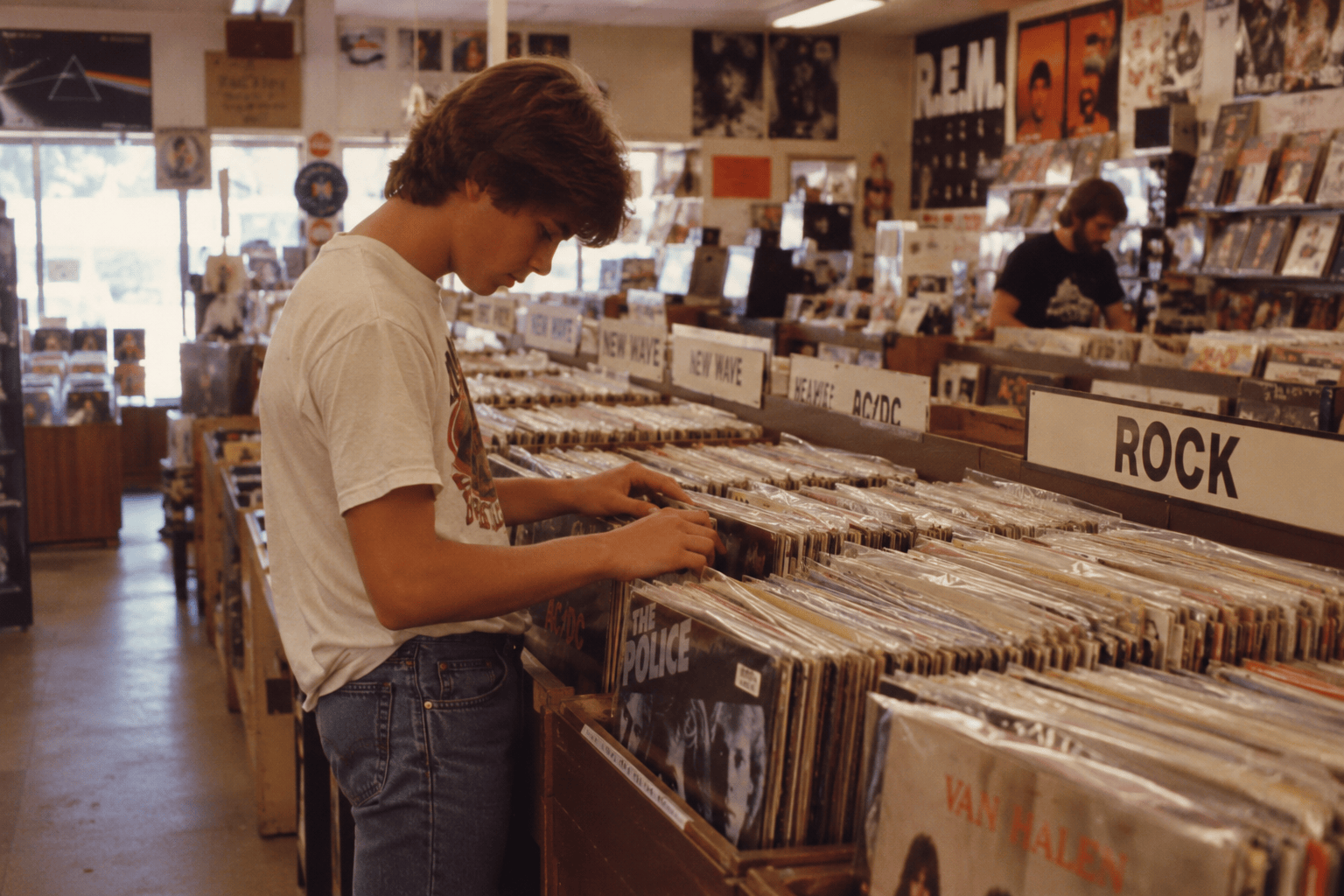
For me, there wasn’t one answer. It was my family, radio DJs, friends, music critics, and record-store employees. Sometimes it was nothing more than an album cover that caught my attention while I was flipping through the records.
Some of those methods worked better than others.
It Started at Home
Long before my friends were recommending albums or record-store employees were setting records aside for me, there was my family.
My dad had a large record collection. He was a big Electric Light Orchestra fan and had all of their albums. He also had Paul McCartney and Wings, Rod Stewart, Jefferson Starship and plenty of others.
Music was always around our house.
One of my favorite memories involves Jefferson Starship’s “Jane.”
A radio station was running a contest where you could win a free album. All you had to do was count how many times Jefferson Starship sang “Jane” during the song.
Dad got the whole family involved.
We all listened and counted. As I remember it, we all came up with a different number.
Dad didn’t win the album.
My sister had a big influence on my musical tastes, too. She loved the Kinks, Cheap Trick, Fleetwood Mac, .38 Special and REO Speedwagon.
Some of her favorite songs became favorites of mine, too. Cheap Trick’s version of “California Man,” .38 Special’s “Fantasy Girl” and Fleetwood Mac’s “Silver Springs” are still favorites today.
She also introduced me to what was probably the first rap or hip-hop song I ever heard. She had the 12-inch single of “White Lines” by Grandmaster Flash and Melle Mel.
I didn’t care for it.
Not every recommendation worked.
My brother influenced me, too. He once talked me into buying Def Leppard’s High ‘n’ Dry.
He wanted the album, but he didn’t have enough money to buy it.
I did.
So he convinced me to buy it.
It worked out pretty well for both of us. He got to listen to the album and I discovered Def Leppard.
Turn on the Radio
Growing up in a small town in northeast Kansas actually gave me a pretty good selection of radio stations.
We could pick up stations from Topeka, Lawrence and Kansas City. KY102 out of Kansas City was probably the one I listened to the most. There was also KLZR out of Lawrence and V100 out of Topeka.
KY102 used to have “Kick Ass Fridays.” I played football in high school, and before one of our big games I called the station and said we were going to kick the other team’s ass.
Apparently, they were listening.
When we got to the game, the other school had made a banner that said, “We heard you on KY.”
My coaches found out I was the one who had called the station. They weren’t real happy with me.
Then we went out and got our asses kicked.
I learned an important lesson that day. Never give your opponent bulletin-board material.
Late at night, I could sometimes pick up WLS from Chicago.
Radio was probably responsible for a lot of albums finding their way into my collection.
Hearing a new song was different then. There was no phone to pull out to immediately find out who was singing it. If the DJ didn’t tell you, you waited. Maybe he would announce it when the song ended. If not, you hoped you’d hear it again.
The DJs were deciding what new music we heard, and after a while you learned which stations and DJs you trusted.
Then Brady Moved to Town
One of the biggest influences on my musical tastes came along when I was in high school.
My friend Brady moved to town. His dad was in radio and had recently been named program director for a station in Topeka. Brady eventually got into radio himself and became a DJ at V100.
Brady had a much larger and more diverse album collection than I did, and we spent a lot of time listening to music.
At the time, I was mostly a straight-up rock-and-roll guy. Brady introduced me to R.E.M., INXS, Marshall Crenshaw and a lot of other music I probably wouldn’t have discovered on my own.
Growing up in a small town probably had something to do with that. There were certain things you were supposed to like. Sometimes you didn’t want to admit you liked something your friends might consider crap. It seems kind of silly now.
Brady helped me get outside that box.
That didn’t mean we gave up hard rock. My brother had already talked me into buying Def Leppard’s High ‘n’ Dry, and Brady and I were both interested in the new hair-metal bands that were starting to show up.
At times, it was like a contest to see who could introduce who to a new band.
Looking back, Brady was probably one of my first algorithms.
The difference was Brady knew me.
The Guy Behind the Counter
Radio and friends could tell you about new music, but eventually you had to go somewhere and buy it.
My favorite record store in Topeka was Mother Earth.
Mother Earth was a record store and head shop rolled into one. I can’t remember the name of the employee who usually helped me, but he figured out pretty quickly that I was a sucker for new music.
Sometimes I would walk in and he would have a few albums behind the counter that he thought I should check out.
He didn’t have my listening history or know how many times I had played a particular song.
He just knew what I liked.
Some of my favorite record-shopping trips, though, were when Brady and I went to Lawrence.
Making the Rounds in Lawrence
Downtown Lawrence was a great place to shop for records in the early 1980s. There were several record stores within walking distance of each other.
Better Days was on Massachusetts Street. Penny Lane was nearby on Vermont. Exile sold used records and tapes just off Mass.
A trip to Lawrence wasn’t about going to one store and heading home. Brady and I would make the rounds.
One of those trips is something he still talks about more than 40 years later.
Looking for Shuttered Room
Brady was looking for the Fixx’s Shuttered Room. I was looking for anything I could find from Shooting Star.
We went from record store to record store in Lawrence. I found the first two Shooting Star albums pretty quickly, but Brady wasn’t having much luck.
After striking out everywhere else, we decided to try Woolworth.
There it was.
Shuttered Room.
At Woolworth.
Today, finding most albums would take about 15 seconds. Pull out your phone, search for the album and hit play.
Ironically, Shuttered Room isn’t available on Spotify. There are some bad re-recorded versions, but not the original album.
Still, if Brady and I had been able to pull out our phones and find Shuttered Room in 15 seconds, would we still be talking about it more than 40 years later?
Sometimes the Cover Was Enough
Not every album needed somebody to recommend it.
Sometimes I bought one because the cover looked cool.
There was something about flipping through racks of albums that made it easy to take a chance. You’d pull out an album, look at the cover, turn it over and read the song titles. Maybe you’d recognize the producer or one of the musicians.
Sometimes you knew one song.
Sometimes you knew nothing.
Sometimes you bought it anyway.
That occasionally worked out great.
Other times, not so much.
At some point I came across an album by a band called Snatch. The album was called If the Party’s in Your Mouth, Then I’m Coming.
I thought the title was funny, so I bought it.
Big mistake.
It is still one of the worst albums I’ve ever bought. The production was terrible. The songs were horrendous. I’m not even sure they knew how to play their instruments.
It was awful.
Apparently my own personal algorithm wasn’t always very good either.
Then There Was Bobby
When I went to college, my friend Bobby started introducing me to even more music.
During our freshman year, he played me XTC, the Cure, the Replacements and the Hoodoo Gurus.
When Mars Needs Guitars! came out, Bobby played it for me.
I thought it was okay.
That was about it.
Then summer came around and for some reason the album clicked with me. It eventually became one of my favorite albums, and it still is.
Bobby heard something in it before I did.
Of course, Bobby wasn’t always right.
He liked the Smiths.
I tried.
I could never get into them.
Bobby also had some strong opinions about music he didn’t like.
He hated Loverboy.
Another guy on our floor had Get Lucky. Bobby saw it one day, picked it up and threw it down the hallway.
I owned Get Lucky, too.
After seeing that, I decided Bobby didn’t need to know.
I hid mine.
What Does an Algorithm Really Know?
I use streaming services today and algorithms can be useful. I’ve discovered music through them that I might not have found otherwise.
But I still trust my friends and my own gut before I trust an algorithm.
Algorithms aren’t always right, either.
They know what’s been played on your account, but they don’t necessarily know who played it. Let somebody else use your device or Spotify account for a while and suddenly your recommendations may not have much to do with what you actually like.
But knowing what I’ve listened to isn’t the same as knowing me.
Brady knew me.
Bobby knew me.
The guy behind the counter at Mother Earth knew what I liked well enough to set aside a few albums he thought I should hear.
And my sister knew me.
One Last Recommendation
My sister continued influencing my musical tastes right up until the end.
She died in 2008.
Not long before she died, she sent me a song through iTunes that she thought I should hear.
I didn’t really like it.
To be honest, I still don’t.
But that doesn’t matter.
It was the last song my sister thought I should hear, so I cherish it now.
No algorithm can do that.
My dad passed away in June.
Now when I hear ELO, I think about his record collection. When I hear Jefferson Starship’s “Jane,” I think about the whole family trying to count how many times they sang “Jane” so Dad could win a free album.
He didn’t win.
But more than 40 years later, I still remember us trying.
When I hear Cheap Trick’s “California Man,” .38 Special’s “Fantasy Girl” or Fleetwood Mac’s “Silver Springs,” I think about my sister.
Who Told Us What to Listen To?
So who told us what to listen to before algorithms?
Everybody.
Our parents. Our brothers and sisters. Our friends. DJs. Music critics. The guy behind the counter at the record store.
And sometimes nobody.
Sometimes we just trusted our own gut and took a chance.
Those methods weren’t necessarily any better at figuring out what we would like than today’s algorithms.
My sister couldn’t convince me to like “White Lines.”
Bobby couldn’t convince me to like the Smiths.
I didn’t think much of Mars Needs Guitars! the first time I heard it.
And when I trusted my own instincts, I somehow ended up buying an album by Snatch.
Maybe algorithms have a better batting average.
But I don’t think that’s the point.
Spotify can recommend a song, but it can’t recreate an afternoon spent going from record store to record store with Brady looking for Shuttered Room.
It can’t recreate the whole family counting every “Jane” in a Jefferson Starship song because Dad was trying to win an album.
And it can’t recreate the last song my sister thought I should hear.
Maybe that’s the biggest difference.
Before algorithms, discovering the music sometimes became as much of a memory as the music itself.
Who introduced you to some of your favorite music before algorithms?
Discover more from Minutes to Memories
Subscribe to get the latest posts sent to your email.

